Subscribe to our newsletter
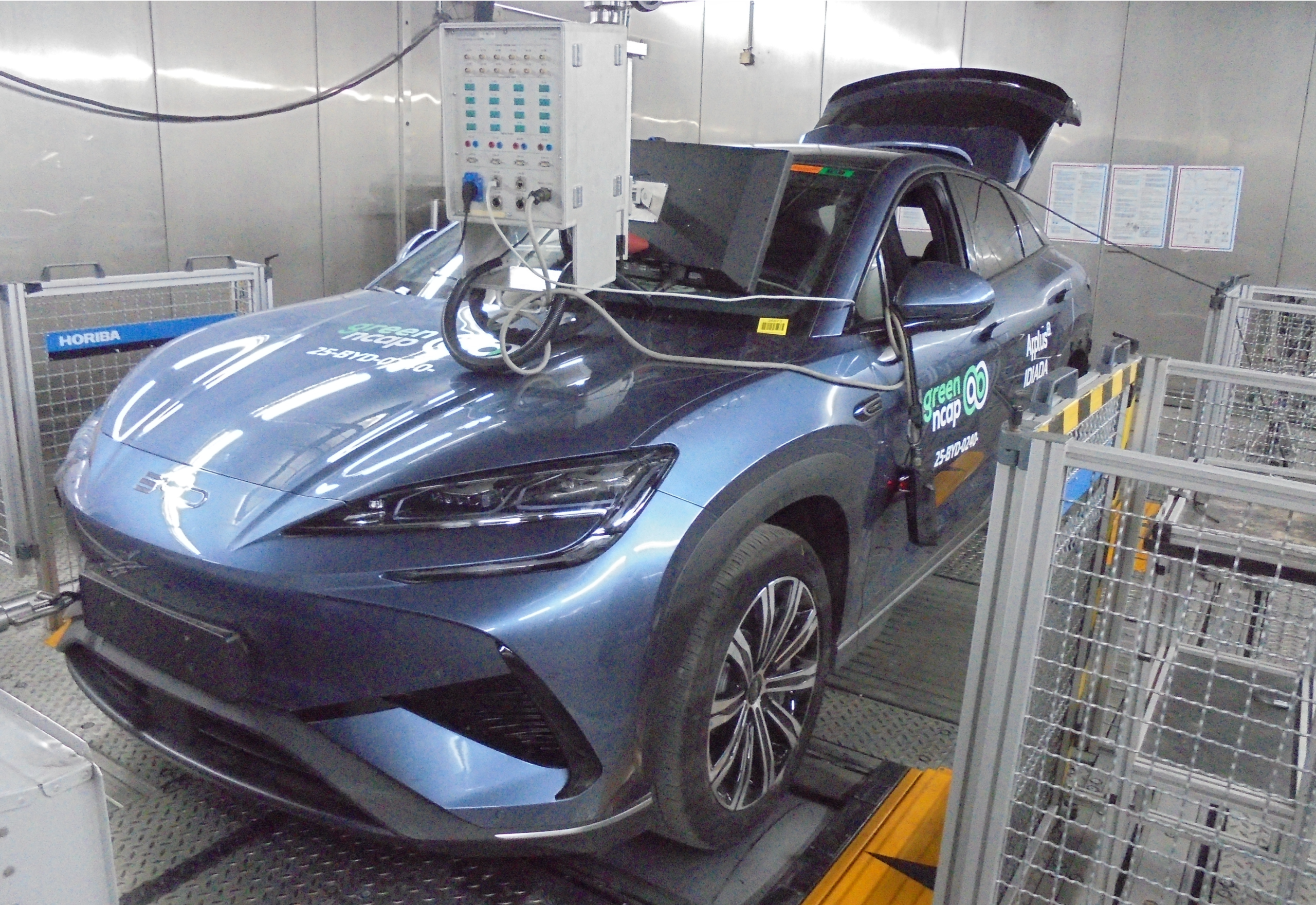 LEUVEN, BELGIUM – Green NCAP testing highlights the trade-offs drivers of both electric and petrol-powered cars can face.
New tests on the electric BYD Sealion 7 and CUPRA Born, along with the petrol-powered BMW 5 Series and X2 give consumers the clearest picture yet of the real-world environmental impact and true efficiency of these four family-friendly cars — at a time when many drivers find it increasingly difficult to choose the option that best fits their needs.
Green NCAP’s latest tests offer vital insight for consumers by focusing on important Driving Experience metrics. For electric vehicles, these metrics encompass factors such as charging performance and the effect of heater use on total driving range, while for conventional cars, they provide real-world estimates of fuel consumption. Taken together, the results demonstrate that cold climates introduce distinct trade-offs for both electric and conventional powertrains in daily driving.
The electric challenge: cold weather still has a chilling effect on usability
The BYD Sealion 7 Comfort, a large SUV with an 82.5 kWh usable battery and a kerb weight of 2,225 kg, proves capable of tackling the inherent cold-weather challenges that typically confront large electric vehicles.
The Sealion 7’s real-world ‘mixed-trip’ range declines from a strong 400 km (248 miles) in warm conditions to 337 km (209 miles) in cold weather, resulting in a relatively modest usability drop of about 16 percent.
Part of the Sealion 7’s ability to offset its diminished cold-weather range lies in its competent cabin pre-warming performance and strong heat-retention capabilities. But once the journey is underway, Green NCAP’s testing shows that the Sealion 7’s charging speed falls short of BYD’s claims. While the tested vehicle briefly reached the declared maximum charging power of 150 kW early in the session, the measured fast-charging time—from 10 to 80 percent battery capacity—was around 8 minutes longer than the officially stated 32 minutes, earning a ‘Poor’ evaluation in this category. Overall, the car was awarded a four-star Sustainability Rating, with a score of 73 percent, a good result for a car this size.
The smaller, lighter CUPRA Born (1,839 kg) does not fare any better in resisting the effects of cold temperatures. The five-door hatchback has a usable battery capacity of 60 kWh, delivering a mixed-route driving range of 328 km (204 miles) in warm weather, which drops to 221 km (137 miles) in cold conditions — a substantial 33 percent reduction.
On the upside, Green NCAP noted the accuracy of the Born’s on-board consumption readings, which its laboratory tests recorded as 27.1 kWh/100 km on the highway, 17.9 kWh/100 km on a mixed on-road route, and a respectable 13.8 kWh/100 km in urban driving. In contrast, the BYD showed poor accuracy in its on-board consumption readings, and it is recommended that the company release a software update to ensure drivers receive clear and reliable information.
The combustion contenders: predictability at the expense of CO2
While electric cars can experience reduced range in cold conditions, the two BMW petrol models — the 520i (1,800 kg) and the X2 sDrive20i (1,620 kg) — deliver predictable fuel consumption compared with the tested electric vehicles.
Both cars were rated ‘Adequate’ for Consumption & Range. Because internal combustion engine (ICE) vehicles use waste heat to warm the cabin, they experience only a moderate increase in fuel consumption in cold weather, rather than the severe range penalty seen in most electric cars.
The 5 Series’ estimated ‘mixed-trip’ fuel consumption increases from 6.8 l/100 km (warm) to 8.1 l/100 km (cold). Similarly, the X2 sees an increase from 7.1 l/100 km (warm) to 8.0 l/100 km (cold). This penalty is modest as well as predictable for drivers and gives greater confidence in real-world driving range than some electric vehicles.
Crucially, both BMWs demonstrate what is achievable with modern ICE exhaust control, performing well in the overall Clean Air Index (the 520i scored 6.5/10, and the X2 scored 6.6/10). These respectable results highlight the effectiveness of their exhaust after-treatment systems in keeping harmful pollutants low, thereby minimising their impact on local air quality.
Overall sustainability: the inevitable gap
The overall Green NCAP Sustainability Rating, which incorporates industry-average emissions from manufacturing and supply chains, highlights the environmental gap between the different powertrains.
The BYD Sealion 7 achieved a highly creditable four-star rating, with an overall Sustainability Rating of 73 percent, thanks to its lack of local tailpipe emissions, strong energy efficiency for its class, as well as profiting from a relatively green European average electricity mix. The CUPRA Born performed even better, earning a four-and-a-half-star Sustainability Rating and a score of 86 percent.
In contrast, the two premium petrol BMWs fell short of the three-star threshold. Both the 520i and X2 sDrive20i earned two-and-a-half stars, with Sustainability Ratings of 46 and 49 percent, respectively. Despite their advanced clean-air technology, the unavoidable CO₂ emissions from burning fossil fuels significantly limit their performance in the Greenhouse Gas Index, underscoring the whole-life environmental advantage of electric vehicles.
Green NCAP’s tests deliver essential, real-world insights for consumers navigating the often-confusing choice between a large EV and a premium petrol car. With the Sealion 7 and CUPRA Born, BYD and CUPRA offer highly appealing options that combine strong performance with lower environmental impact — a win for many buyers. However, as with all electric vehicles, drivers should be mindful of the significant range reductions that can occur in cold winter conditions.
Conversely, the BMWs provide predictable range and the convenience of easy refuelling, but they remain bound by the inherent carbon footprint of burning fossil fuels. The industry’s focus must now turn to perfecting EV thermal management to eliminate cold-weather range anxiety. With the Sealion 7, BYD demonstrates that the sector is moving decisively in the right direction, offering a glimpse of what well-designed electric vehicles can achieve. — Dr. Aleksandar Damyanov, Technical Manager Green NCAP
Additional note to this release: some recent test results have been corrected for accuracy and modified accordingly on Green NCAP’s website.
About Green NCAP Established in 2019, Green NCAP is an independent, non-profit organisation established to promote the development of more sustainable cars and trucks. For the first time, the introduction of Green NCAP’s whole-life assessment of new vehicles means consumers can see and compare the true environmental impact of cars throughout their lifecycle, and compare their real-world efficiency, range, and charging capability.
Each car’s Sustainability Rating is presented in a comprehensive report that can be browsed online or downloaded.
Editor’s note For full results, visit www.greenncap.com or Green NCAP’s newsroom for journalists. For media information, please contact Cordelia Wilson at media@greenncap.com.